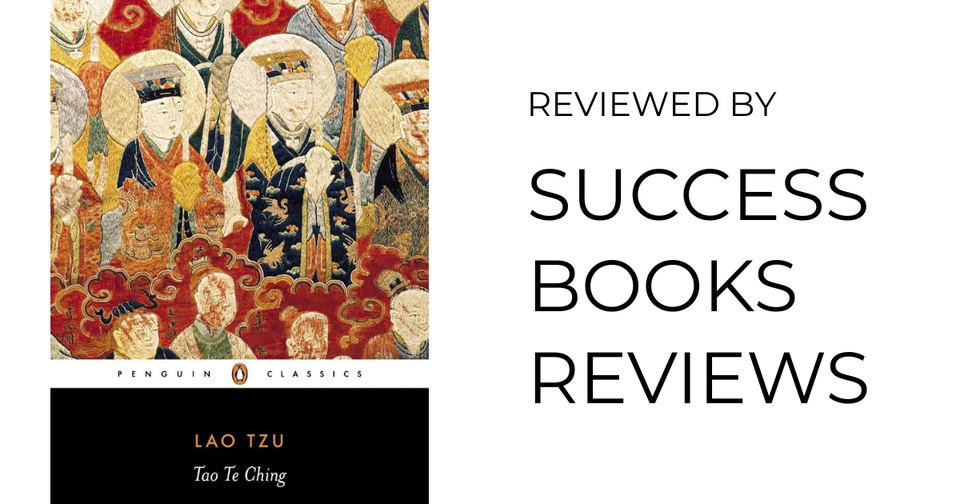
Tao Te Ching - Lao Tzu, translated by D. C. Lau (Review)
Summary
Few books challenge conventional ideas about success as fundamentally as the Tao Te Ching. Traditionally attributed to Lao Tzu, this brief collection of 81 chapters explores the Tao - the Way that cannot finally be captured in concepts - and a way of living characterised by simplicity, receptivity, non-grasping, humility, and wu wei: action without forcing.
From its opening lines, the text questions our tendency to mistake names, categories, and judgments for reality itself. The Tao that can be described is not the constant Tao; once reality is named, divided, compared, and evaluated, we are already dealing partly with our conceptual representation of it rather than with what is immediately present. Scholarly treatments emphasise that, for the Tao Te Ching, names delimit and define, while the Tao cannot be contained by such boundaries.
For readers approaching the book from a contemplative or non-dual perspective, this can also be read experientially: before thought labels an experience desirable or undesirable, beautiful or ugly, successful or unsuccessful, there is simply the immediacy of experience itself. The Tao Te Ching does not formulate this in the terminology of modern non-duality, but its repeated movement away from naming, grasping, striving, and self-conscious control points strongly in that direction.
This becomes especially important in its treatment of wu wei. Commonly translated as “non-action,” the idea is better understood as action without unnecessary forcing, contrivance, or self-interested interference. The sage does not become passive; action continues, but with less friction between the actor and the situation. Classical interpretation closely connects wu wei with ziran - naturalness or things being so “of themselves.”
Readers interested in direct awareness beyond compulsive thought may also enjoy our review of The Power of Now, which similarly questions identification with thought and the sense of a separate controlling self. Discourses of Epictetus offers an illuminating Stoic comparison: both Stoicism and Taoism counsel acceptance of what cannot be forced, but the Tao Te Ching goes further in loosening the idea of a distinct individual will that must remain in control.
Selected Passages
The following quotations are from James Legge’s 1891 public-domain translation, not the D. C. Lau edition reviewed here.
Naming Is Not the Reality
Chapter 1 begins:
“The Tao that can be trodden is not the enduring and unchanging Tao. The name that can be named is not the enduring and unchanging name.”
It continues by contrasting the nameless origin with the named world of differentiated things.
This opening establishes one of the book’s deepest themes. A name is useful, but it is not the thing itself. Naming creates distinctions and boundaries; direct experience precedes those distinctions.
Chapter 2 immediately develops the idea:
“All in the world know the beauty of the beautiful, and in doing this they have (the idea of) what ugliness is…”
Beauty and ugliness, difficult and easy, long and short, high and low arise through contrast.
For a modern reader, there is a striking experiential implication: much of what we call reality is already filtered through comparison, evaluation, memory, and language. The Tao Te Ching repeatedly invites us to notice what remains when that constant conceptual overlay relaxes.
Wu Wei: Accomplishment Without Forcing
Later in Chapter 2:
“Therefore the sage manages affairs without doing anything…”
and, after describing things arising and developing naturally:
“The work is accomplished, and there is no resting in it (as an achievement).”
This is central to the book’s unusual relationship with success. Achievement is not rejected. Work is completed. Things are accomplished. What falls away is the compulsive identification with being the achiever - the need to possess the result, claim credit, or construct identity around success.
Chapter 37 states the principle even more directly:
“The Tao in its regular course does nothing (for the sake of doing it), and so there is nothing which it does not do.”
And Chapter 48 offers perhaps the strongest counterpoint to conventional self-improvement literature:
“He who devotes himself to learning… from day to day [seeks] to increase…; he who devotes himself to the Tao… from day to day [seeks] to diminish…”
until:
“Having arrived at this point of non-action, there is nothing which he does not do.”
Success here does not necessarily come from adding more effort, control, knowledge, status, or technique. Sometimes it comes through removing interference.
Who This Book Is For
- Readers questioning conventional ideas about achievement, ambition, and control
- Anyone interested in Taoism, philosophy, contemplation, or non-dual perspectives
- Leaders and professionals interested in acting effectively without unnecessary force
- Readers drawn to simplicity, direct experience, and non-striving
- Those interested in the relationship between language, thought, and reality
- Readers of Stoicism looking for a contrasting approach to agency and control
- Anyone who has discovered that increasing effort does not always produce better results
Key Takeaways
- Reality exceeds our descriptions of it: Names and concepts are useful, but they should not be confused with what they describe.
- Judgment creates opposites: Beautiful and ugly, success and failure, difficult and easy acquire meaning relationally rather than existing as completely independent categories.
- Direct experience comes before interpretation: We normally encounter life through an almost immediate layer of naming and evaluation; the text repeatedly points toward something prior to this conceptual division.
- Wu wei is not simple passivity: It is action without unnecessary forcing, manipulation, or self-conscious interference.
- Effective action can feel effortless: Skillful action often arises from responsiveness to circumstances rather than imposing a preconceived plan.
- Success need not be possessed: Work can be completed without converting achievement into identity, status, or self-importance.
- Less can accomplish more: The text repeatedly favours subtraction - less desire, less interference, less excess, less compulsive doing.
- Contentment changes the meaning of wealth: Chapter 33 famously connects knowing sufficiency with being rich.
- Softness can be stronger than force: Flexibility, receptivity, and adaptability frequently succeed where rigidity fails.
- Leadership can operate through restraint: The best influence may sometimes involve creating conditions in which people and systems can function naturally rather than controlling every outcome.
- Nature does not strive: One of the book’s recurring images is of processes unfolding without the anxious sense of an individual agent forcing them into existence.
- The self need not stand outside life: Read contemplatively, the text repeatedly loosens the division between a controlling subject and a world that must be managed.
Strengths
- Extraordinary depth compressed into a very short text
- Challenges assumptions at the foundation of conventional success literature
- Offers a radical alternative to constant striving, optimisation, and self-improvement
- Combines philosophical insight with practical implications for leadership and everyday action
- Rewards repeated reading rather than being exhausted after a single pass
- Provides a powerful counterbalance to cultures of overwork, competition, and excessive control
- Its treatment of language and naming remains highly relevant to how humans construct experience
- The concept of wu wei offers a sophisticated alternative to both passivity and aggressive effort
- Its emphasis on humility, simplicity, flexibility, and non-possession has applications well beyond explicitly spiritual life
- Can be read philosophically, psychologically, politically, contemplatively, or mystically without being reducible to any single one of those approaches
Weaknesses
- The extreme compression and ambiguity of the text make misinterpretation easy
- Important Chinese concepts such as dao, de, wu, ziran, and wu wei have no exact English equivalents
- Different translations can produce substantially different impressions of the same chapter
- Modern spiritual readings can sometimes impose later ideas - particularly explicit non-dual metaphysics - more strongly than the original text itself warrants
- Some passages concerning rulers and government can seem remote from contemporary personal-development concerns
- Readers looking for a sequential argument or practical step-by-step method may find the text frustratingly indirect
- Its paradoxes are intended to disrupt habitual thinking rather than resolve neatly into fixed propositions
Verdict
The Tao Te Ching is one of the rare books that does not merely offer different strategies for becoming successful; it asks us to reconsider the structure of striving itself.
Its opening challenge is profound: the name is not the reality. Our labels, judgments, comparisons, goals, and identities may help us navigate the world, but they can also obscure the immediacy of what is actually happening. Once everything has been divided into success and failure, gain and loss, desirable and undesirable, we can spend much of life attempting to manipulate experience into conformity with those categories.
Against this, the Tao Te Ching offers wu wei - not inactivity, but action free from unnecessary forcing. Work is still done. Decisions are still made. Leadership still occurs. Skill, effectiveness, and accomplishment remain possible. But they need not arise from anxiety, grasping, self-assertion, or the constant construction of an individual achiever.
This makes the book unusually relevant to the idea of success. There is professional success in knowing when not to interfere. Creative success in allowing skill to operate without excessive self-consciousness. Relational success in not trying to control other people. Personal success in knowing what is enough. And, at the deepest level, perhaps a form of success in which the distinction between the person pursuing life and life itself becomes less rigid.
The Tao Te Ching does not ask the reader merely to adopt another belief system. Its paradoxes continually push thought toward its own limits, leaving open the possibility of encountering experience before it is immediately named, judged, possessed, or resisted.
Rating: ★★★★★ (5/5)
Editor’s Pick
Where to Get It
This book is widely available through major online and local booksellers, including Amazon and independent retailers.
For this review we recommend the D. C. Lau translation, whose restrained approach provides a strong basis for engaging with the text without imposing excessive modern interpretation.