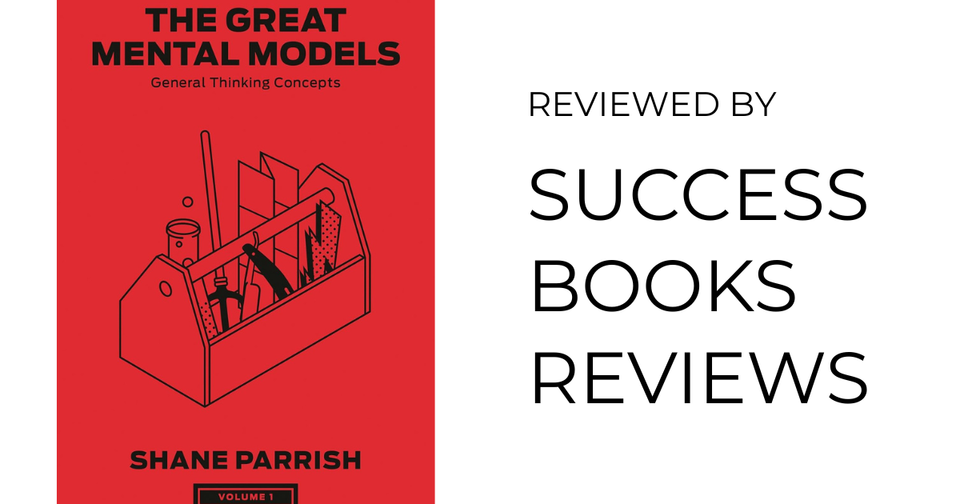
The Great Mental Models, Volume 1: General Thinking Concepts - Shane Parrish and Rhiannon Beaubien (Review)
Summary
The Great Mental Models, Volume 1 introduces a selection of foundational thinking frameworks designed to improve judgment, problem-solving, and decision-making. Shane Parrish and Rhiannon Beaubien draw ideas from mathematics, physics, biology, economics, psychology, and systems theory, showing how concepts developed in one field can help readers understand problems in another.
The book encourages readers to build a broad “latticework” of knowledge rather than relying on a single way of interpreting the world. Each mental model provides a different lens through which to examine causes, consequences, incentives, uncertainty, and complex systems.
Readers interested in applying clearer thinking to everyday decisions may also enjoy our review of Clear Thinking. For a deeper examination of cognitive bias and the mental shortcuts that affect judgment, see our review of Thinking, Fast and Slow.
Who This Book Is For
- Readers interested in critical thinking, reasoning, and decision-making
- Leaders and professionals responsible for solving complex problems
- Entrepreneurs seeking more adaptable ways to assess opportunities and risks
- Lifelong learners interested in drawing insights from multiple disciplines
- Readers who want an accessible introduction to mental models
Key Takeaways
- Use multiple perspectives: Complex problems are rarely understood fully through a single discipline or framework.
- Build a latticework of knowledge: Connecting models from different fields creates a more flexible and reliable way of thinking.
- Understand first principles: Breaking a problem down to its fundamental truths can reveal assumptions that might otherwise go unquestioned.
- Consider second-order effects: Decisions often produce consequences beyond their most immediate and visible results.
- Recognise incentives: Behaviour becomes easier to understand when the incentives influencing individuals and organisations are examined.
- Look for feedback loops: Actions within a system can reinforce or counteract one another, producing effects that may grow over time.
- Allow for uncertainty: Good decisions do not guarantee good outcomes, particularly where chance and incomplete information are involved.
- Avoid using one model everywhere: Every framework has limits, and applying the wrong model can create false confidence.
Strengths
- Makes sophisticated ideas understandable without excessive technical language
- Introduces useful concepts from a wide range of disciplines
- Encourages curiosity and intellectual flexibility
- Highly relevant to leadership, business, strategy, and everyday decision-making
- Provides a strong foundation for further reading and study
- Organises abstract concepts around practical questions and recognisable problems
- Complements books on cognitive bias by focusing on constructive tools for reasoning
Weaknesses
- Many of the models are introduced only briefly and require further reading for deeper understanding
- Readers seeking detailed exercises or step-by-step applications may find the treatment too conceptual
- The wide range of disciplines means some sections inevitably feel more developed than others
- Examples occasionally simplify complex historical or scientific ideas
- The book works better as an introduction than as a comprehensive reference
- Readers already familiar with first principles, incentives, probabilistic thinking, and systems theory may encounter substantial familiar material
Verdict
The Great Mental Models, Volume 1 is an accessible and valuable introduction to interdisciplinary thinking. Its central strength is not any single framework, but the argument that better judgment comes from learning to examine problems through several complementary lenses.
The book does not provide a formula that guarantees correct decisions. Instead, it offers a practical intellectual toolkit that can help readers identify assumptions, anticipate consequences, and understand complex situations more clearly. Although some models receive only introductory treatment, the collection provides a strong starting point for anyone seeking to improve the quality of their thinking.
Rating: ★★★★☆ (4/5)
Where to Get It
This book is widely available through major online and local booksellers.